







Skiing in Ischgl
Ischgl has a big ski area which extends across the Austrian-Swiss border to reach Samnaun. Intermediate-friendly red and blue pistes predominate but there are tougher slopes for experts and good nursery slopes for beginners too. And there are more skiing a bus ride away in the other Paznaun ski resorts.
Ischgl Ski Area Overview
Ischgl’s ski area extends to Samnaun in Switzerland, a duty-free enclave that is a cross between a picturesque Swiss village and a tax-free showroom. It’s divided into different sectors, with all the lifts inside each sector starting with the same letter.
Ischgl (Sector A)
Ischgl has three lifts (A1, A2 and A3) in the centre and north-east end of the resort, A1 and A3 go to Idalp, A2 to Pardatschgrat. Whilst most skiers going up to Idalp will either stay in that bowl or move onto one of the other sectors, you can stay in sector A, by turning around and skiing back to Ischgl on slope 1, a red piste with optional black runs and ski routes coming off it. It’s mostly treelined, so it can be a good option in bad visibility, and whilst the run is always crowded at the end of day with skiers returning to the resort, it’s often neglected in the morning, when it’s usually in perfect condition after overnight grooming.
Idalp (Sector B)
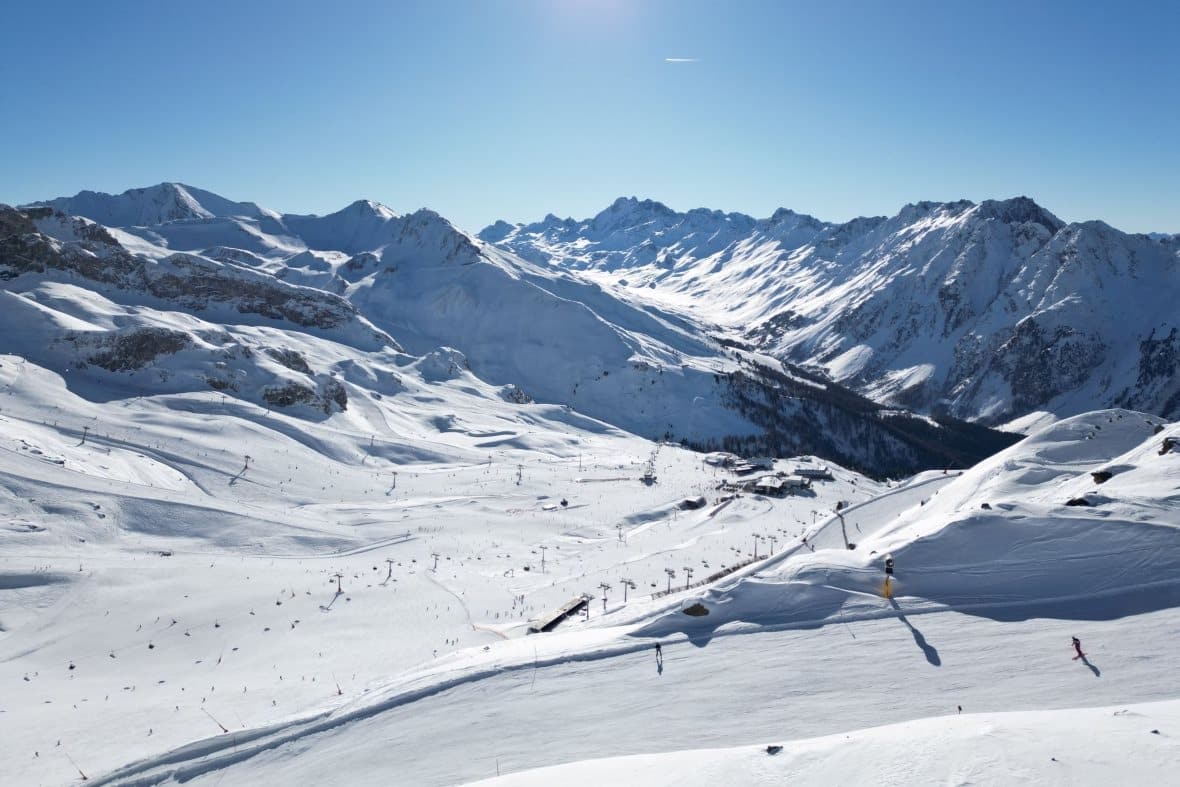
Idalp (c) Ischgl Tourismus
Idalp is the crossroads for the whole ski area and often thronged with skiers studying piste maps as they try to get their bearings, which can take some time, as there are 9 lifts that radiate outwards from the centre of Idalp (B1,B2,B3,B5,B6,B6,B7, B8, B9 and B10), plus three major lifts that end here (A1 and A3 from Ischgl, plus C1 from Höllboden). And Idalp is also home to Ischgl’s nursery slopes, plus a huge complex which houses a large self-service and waiter service restaurant, a ski hire shop, ski storage depot and several ski schools. So it gets very busy.
As well as being a staging post for skiers coming up on the A1 and A3 lifts before they move onto other sectors, Idalp is often seen as an area for beginners, novices and nervous intermediates, who not only have dedicated beginners’ areas, but long gentle blue runs coming down from Velillscharte, Pardatschgrad and Voderjoch, that pass through Idalp and continue onto Höllboden (see below). But on all sides of these are steeper red and black runs, particularly black run 13 descending from Greitspitze.
Höllboden-Greitspitze (Sector C)
Sector C has some of Ischgl’s gentlest runs, and also some of its steepest. Most skiers reach it not by lift but by skiing down the easy blue piste (slope 2) from Idalp which takes you to the ski lifts and restaurant at Höllboden. As well as a large restaurant, there are three lifts here: C1 returns you to Idalp; C2 takes you up a gentle sloping valley to Höllkar and Sector D; and C3 gets you over the far ridge so you can ski down the Piz Val Gronda, Palinkopf,and Höllspitz (Sector E). But if you stay in the valley, you’re mostly on easy blue runs and reds that are only slightly steeper – unless you veer off to the left and take the C5 lift which goes to the summit of Greitspitze, Around this lift are the ski area’s highest and steepest runs.
Höllkar-Palinkopf (Sector D)
The steep black runs around the C5 lift aren’t the only challenging slopes descending into the Höllboden-Höllkar valley. They are mirrored on its other side by steep black runs coming down Palinkopf near the D1 and D2 lifts. But there are easier red runs on the far side which head towards Samnaun (L Sector) and Piz Val Gronda E sector) and the E sector. And on the steep front face of Palinkopf near the steep black runs is a single blue run (22) which curls along the ridge of the bowl before snaking down to Höllkar.
Piz Val Gronda, Palinkopf, Höllspitz (Sector E)
The E sector is the furthest south from Ischgl and on the top right hand corner of the piste map. It’s mostly composed of red runs, plus some black pistes and ski routes. It’s also a great area for off-piste skiing with a guide and has some nice mountain restaurants. The highlight is the red run and ski route from Piz Val Gronda (slope 42), but red piste 40 and black piste 33/34 are also nice long runs.
Pardatschgrad (Sector F)
Most skiers from Ischgl start their skiing at Idalp, but not all, because the A2 gondola from the resort arrives at Pardatschgrad. You can ski straight down into Idalp from Pardatschgrad on either a blue or red run, but you don’t have to, because you can also turn around and ski in the opposite direction, down the Pardatschgrad–Velill mountainside to the F1 and F2 lifts which bring you back up to the summit again. (Or you can keep going below these lifts all the way to Ischgl as all the runs eventually merge into piste 1 in Sector A). There are no blue pistes on this side of the sector: it’s all reds and blacks, with the isolated red piste 7 and the steep black run 4 being the highlights.
Schwarzwasser-Mathon (Sector G)
Sector G is not really a sector, because its two lifts are miles apart and separated by a range of mountains that you can’t cross on skis. But one of its lifts, Schwarzwasser (G2) is extremely useful because it spans a flat section near the bottom of piste 3, which is the main route back to Ischgl from the C, D and E sectors. So instead of having to skate and push for nearly 0.7km, you can be pulled across the flat ground on a draglift. The other lift, G1 is a practice lift serving two small nursery slopes outside the village of Mathon near Ischgl.
Samnaun Ravaisch (Sector L)

Skiing into Samnaun (c) Dominik Täuber
Samnaun Ravaisch is where the large Samnaun gondola and chairlift are, which connect Samanun to Alptrider Sattel from where you can ski down to Alp Trida and the N sector, and then onto the rest of the ski area.
There are two ways to reach Samnaun Ravaisch: the longest is via piste 80, a red run from the top of Palinkopf. This is a very long but also very gentle red piste, which becomes a blue as it flattens out on the outskirts of Samnaun Dorf. You can skirt around Samnaun Dorf and ski all the way to the cable car station in Samnaun Ravaisch, with a bit of skating and pushing. But it’s more interesting to stop and wander through it to see duty free showrooms cheek by jowl with ancient heavily-timbered gasthauses and restaurants.
The other way to reach the lifts at Samnaun Ravaisch is to take slope 60, a blue piste, from Alp Trida. This is even less steep than piste 80, but it can have poorer snow. And unlike piste 80, piste 60 doesn’t take you all the way into Samnaun Ravaisch. Instead it descends to Samnaun Compatsch from where you take a bus to Samnaun Ravaisch.
Alp Bella (Sector M)
Alp Bella is a small, isolated and often uncrowded sector in the Samnaun half of the ski area, adjacent to the more popular Alp Trida/N sector (see below). It only has 2 lifts (M1 and M2) and three pistes, all reds, one of which continues through Alp Bella, and joins the Duty Free Run (piste 60 – see above) from Alp Trida to Samnaun Compatsch.
Alp Trida (Sector N)
Alp Trida is at the centre of the Samnaun ski area, lying in between the Apl Bella /M and Salaas/O sectors, and with Idalp, on the other side of the Viderjoch and Idjoch ridge (which is the Austria-Switzerland border). At its centre are two restaurants and four lifts (N1, N2, N3 and N4) and some restaurants. The main east-facing central slope coming down from Viderjoch and Idjoch near the N1 and N4 lifts is easy blue piste terrain (although there is one red piste here as well) but there is steeper stuff to either side.
Salaas (Sector O)
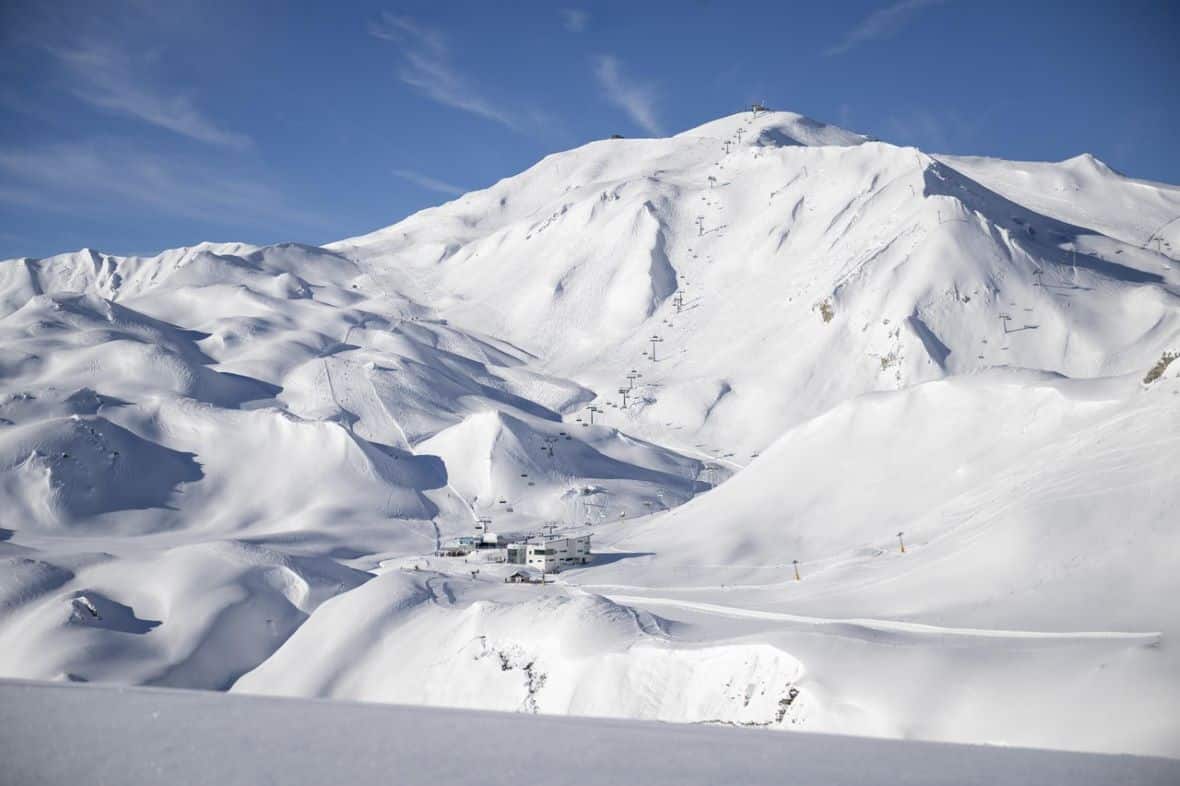
Salaas sector in Samnaun (c) Mayk Wendt
Salaas is a small but high sector on the Samnaun side of Idjoch and Greitspitze, and also accessible from Alp Trida via the N4 lift. The runs down to it from the B3 and N4 lifts are easy blues, but those from B4 and C5 on Greitspitze are steeper reds. At the bottom is a restaurant and ski lifts returning you to Alp Trida (O2), Idjoch (O4) and Greitspitze (O1).
Samnaun Dorf (Sector P)
As you ski into Samanun Dorf on the red Duty Free Run (piste 80) from Palinkopf, you pass a large beginners’ area to your left with 3 lifts (P1, P2, P3). These are very useful for beginners in Samnaun, but are of very little interest to red run skiers from Ischgl, unless they want to prove a point by taking every lift, and skiing every slope, in the ski area.
The Paznaun Valley Ski Resorts
The Ischgl-Samnaun ski are is large enough for most visitors to Ischgl. But there is more skiing available if you want it in the other Paznaun valley ski resorts which are connected to Ischgl by a regular ski bus service.
Galtür
Galtür which is about 15 minutes away from Ischgl. Buses are free to guest-card/lift-pass holders, and leave every 30 minutes. The resort itself is located at 1,584m. It’s a quiet, traditional village, with houses clustered around a church, although most of what you see had to be rebuilt after being hit by a devastating avalanche in 1999. The ski area is a short bus ride from the village, with 43km of slopes between 1,600m and 2,300m. Most are unthreatening red and blue pistes, making Galtür a good choice for families seeking gentle slopes in peaceful surroundings when Ischgl is too crowded and noisy.
Kappl & See
Kappl & See are really two ski areas. Each is about the same size as Galtür so together they are about double its size, and whilst people do set off from Ischgl intending to ski both of them in a single day, it’s hard work. Together they have about 84k of slopes between 1,180m and 2,690 meters: most are red pistes but there are steep ski routes too. Both villages are bus-linked to Ischgl: the bus stops at Kappl and continues onto See, and it’s free to Ischgl guest-card/lift-pass holders.
Beginner Skiing in Ischgl
Although Ischgl is an expensive ski resort for beginners to learn in because they have to buy the full lift pass to travel to and from the nursery slopes at Idalp, they do benefit from a large beginners’ area which is both snowsure and sunny.
Beginners must take one of the two gondola lifts from the resort that go up to Idalp. The ski school has offices here and there are ski, board and boot hire shops. But lessons should have been organised beforehand at the ski school office in the village.
Although Ischgl is not known as a beginners’ resort, the fact that the nursery slopes are at high altitude means that they are snowsure and often sunny too. There is a good range of slopes: the shortest are accessed by magic-carpet lifts, then there are slightly longer ones next to drag lifts, and finally a special child-friendly chair lift which accesses a proper blue run. And there are more blue runs nearby for further progression.
There is no easy run back to the resort, however, so beginners have to come down, as well as come up, in the lift. And Idalp can get very crowded.
Ski Schools & Ski Lessons in Ischgl
Looking for private or group ski lessons in Ischgl? CheckYeti works with leading ski schools and ski instructors in over 500 ski destinations throughout Austria, France, Germany, Italy and Switzerland. Let them help you choose the right ski school or instructor for you. Qualified and experienced ski instructors and guides at 500+ ski destinations, 6,000+ offers and 24,000+ ski school reviews. View ski schools, classes, offers and discounts, and pre-book your ski lessons online.
Book Ski School Lessons Online Now >
Intermediate Skiing in Ischgl
Both Ischgl and neighbouring Samnaun have a wealth of blue and red runs, usually very well groomed and ripe for cruising.
Ischgl is a superb ski resort for intermediate-skiers. The pistes tend to be generously graded, so nervous intermediates who normally stick to blues should try some of the reds as well once they’ve gained some confidence, including the long red Duty Free Run (piste 80) from Palinkopf to Samnaun.
But if they insist on blue run only skiing, the best sectors are Idalp (B) and Alp Trida (N), including the blue Duty Free Run to Samnaun on blue piste 60. Höllboden (C) and Salaas (O) are also easy to explore on blue runs, provided you avoid the lifts going up Greitspitze (C5 and O1). And there is also the option of spending a quiet relaxed day in Galtur.
Red run skiers will enjoy the whole of the Ischgl-Samnaun ski area, so should explore all its sectors, including its lesser-visited extremities at Velill (F), Alp Bella (M) and Piz Val Gronda (E), which all have good red runs. (Technically the lower-half of slope 42 on Piz Val Gronda is a ski route, but it’s only tricky to ski in poor snow conditions.)
The only slopes they should consciously avoid are the steep black runs around the C5, D1, D2, and F1 lifts, but these are clearly signed and there are nearby red runs which they can ski instead.
And most red run skiers will enjoy a day in Kappl & See too.
Advanced & Expert Skiing in Ischgl

Freeride skier in Ischgl (c) Ischgl Tourismus
Advanced skiers have steep black pistes and extreme ski routes, plus plenty of backcountry skiing that can be explored with a guide, especially around Piz Val Gronda.
Greitspitz/Grietspitze
Greitspitze (it’s spelt with or without the e) is the highest point of the ski area at 2,872m (9,422ft). There are freeride options (and dangers) all around: you can spot most of them from the B4, O1 and C5 lifts, but you really need a guide to tackle them safely. If you want to stick to the pistes, there are multiple black runs descending from the summit on all sides. 14a is the steepest but they are all worth trying.
Palinkopf
Palinkopf has excellent freeride, including official avalanche-secured ski routes (39 and 36). But there’s also a lot of unofficial between-the-pistes freeride, and itineraries that guides can show you which go further from the pistes. Palinkopf also has black runs on both sides of the mountain. 20 and 21 are short but steep whilst pistes 33 and 34 form a longer but easier continuous descent to Paznauner Taya. Black piste 35 also has its challenges.
Piz Val Gronda
The Val Gronda lift, rising to over 2800m, opens up plenty of freeride. There is only one official run down (a red piste which morphs into an ungroomed ski route) but a guide can show you plenty of other variants, some requiring a short hike, that can take you a long way from the piste network. Access to the north ridge is restricted, however, for environmental reasons.
Pardatschgrat
Back at the eastern side of the ski area, black run 4 near the F1 lift on Pardatschgrat is genuinely testing. There is also good off-piste around here too, and nearby are the steep ski routes that swerve off to the left from piste 1, cross under A1 and A3 gondolas and head down through the woods to the G2 drag lift.
Boarding & Freestyle in Ischgl
Ischgl has always been big on boarding and freestyle and has what is widely recognised as one of the best snowparks in Europe at Idalp
Ischgl was one of the first resorts in Europe to realise the potential popularity of boarding and embraced it wholeheartedly while many others were eying it suspiciously.
The Ischgl Snow Park at Idalp is really two snowparks with two park areas, one funline, one bag jump and a special speed line for action-fuelled races.
And Ischgl also caters for boarding beginners, with boarder-friendly lifts and nursery slopes. And the vast, wide open powder fields are boarder heaven for freeriders after a fresh snowfall.
Mountain Restaurants in Ischgl
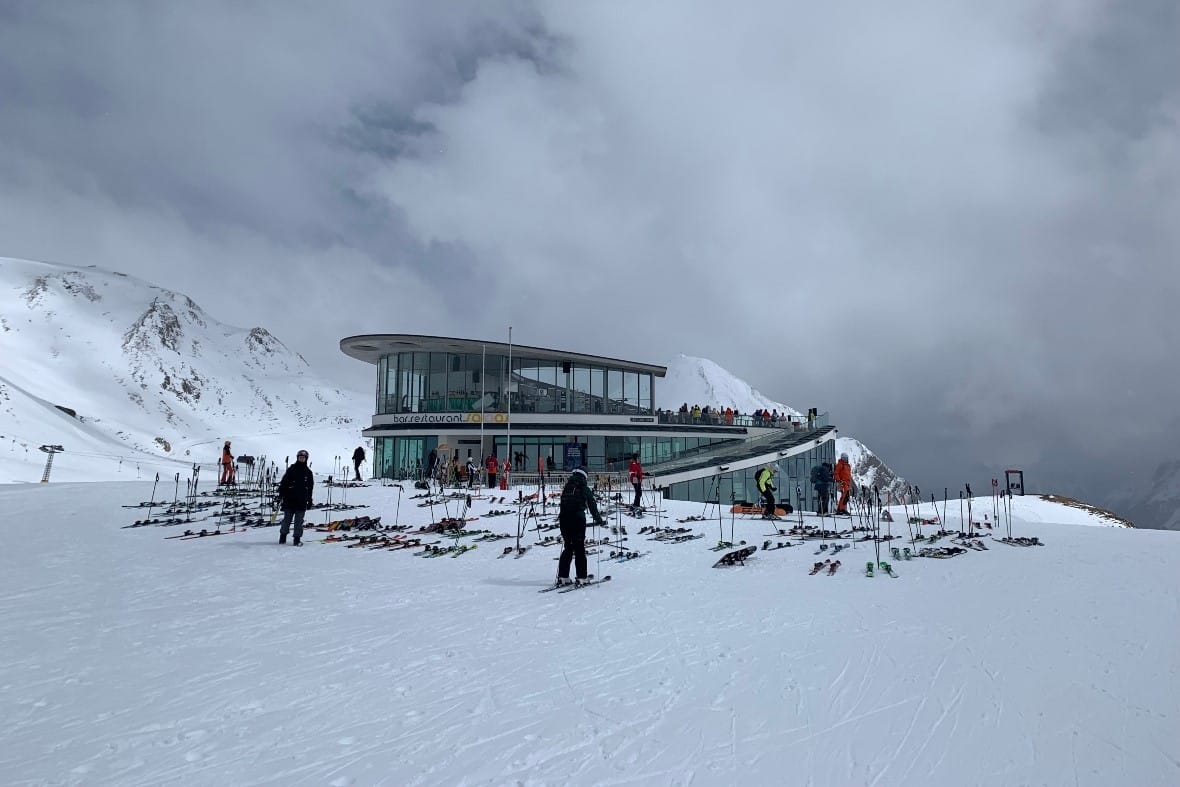
Even on an overcast afternoon, the DJ on the Salaas restaurant roof terrace attracts revellers
Ischgl and Samnaun have about 15 mountain restaurants between them, which isn’t many, so they tend to be big, and not particularly beautiful. But food quality is generally high, prices reasonable, and some of them are lively apres-ski venues too.
Ischgl has both proper restaurants with table service and self-services cafes. And many of the restaurants have big terraces with a separate bar or kiosk too. However the ski area lacks traditional small ‘mountain huts’ that are popular elsewhere in Austria and Switzerland
The restaurant at Idalp has a relatively inexpensive self-service cafe and a more upmarket waiter-service restaurant (Panorama). Both are housed in a large institutional-looking building but the food’s good and there’s a nice roof terrace on sunny days. The restaurant at Höllboden is similar but smaller, with less outdoor space. It’s renowned for its fondues, which are best booked in advance, and its pizzas which are ordered from a different counter.
The Paznauner Thaya is full of character and very popular. It has table service upstairs – and often a band or a DJ on the terrace. If you want somewhere quieter, try the remote waiter-service restaurant at Gampenalp near Val Gronda. Bodenalp has a cosy waiter-service restaurant too, but its sun terrace can be a party venue later on.
The Pardorama, at the top of Pardatschgrat, has both waiter-service and self-service restaurants, but what really sets it apart is that it’s at the top of the mountain, at over 2,600m, rather than down in the valley. so it has the best views of all the Ischgl mountain restaurants.
Over in Samnaun, the restaurants will bill you in Swiss Francs unless you ask to pay in Euros in cash. Their duty-free prices are inexpensive for mountain restaurants in Swiss ski resorts, but not amazingly cheap. The large modern restaurant at Salaas (see photo above) has a champagne bar on its terrace, and usually a DJ too, who will usually start pumping out music from lunchtime onwards. In Alp Trida, the Skihause has both waiter-service and self-service, whilst La Marmotte is self-service only with a separate kiosk for its popular apres-ski bar. The Sattel, at Alptrider Sattel, has a smart restaurant and an outdoor terrace with the best views on the Swiss side (see below).

Sattel Restaurant at Alptrider Sattel above Samnaun (c) Andrea Badrutt